Příkrý

The municipality of Příkrý is situated on a steep north-western slope, which runs down through the valleys of streams into the valley of the Vošmenda River, one of the tributaries of the Jizera River. The municipality today consists of two formerly separate villages – Příkrý and Škodějov.
Příkrý is a relatively young municipality by Czech standards. It was established during one of the waves of colonisation of the Horní Pojizeří region and is first mentioned in the urbarium of Semily in 1634, while the first records of Škodějov date from as early as the 14th century.
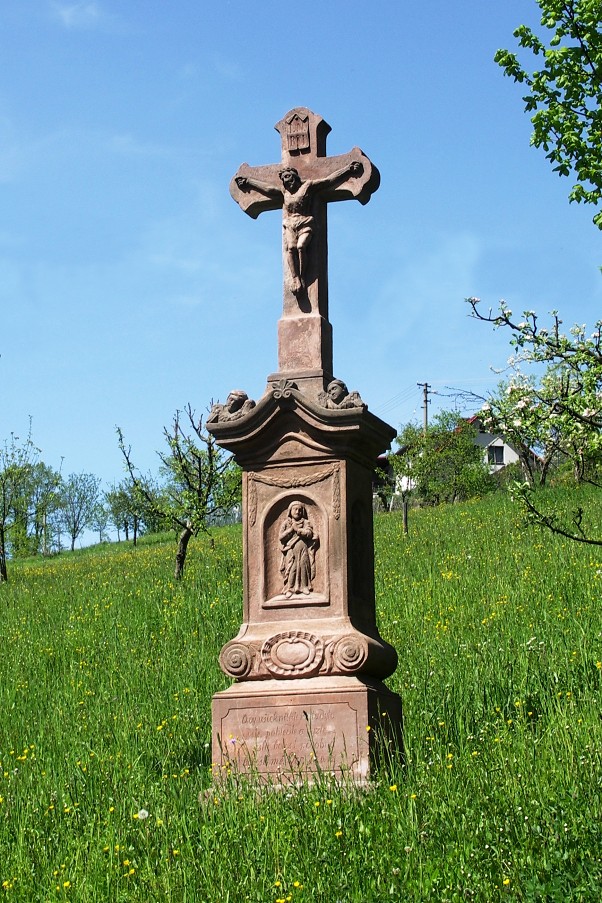
The two parts of the municipality are separated from one another by naturally rolling countryside with the hills of Na Vrších (593 m a.s.l.), Skalka (610 m a.s.l.) and Benešov (568 m a.s.l.). Several timbered cottages have been preserved in Příkrý, one of which is listed as a cultural heritage site, and there are also two bell towers, two sandstone crosses and a valuable group of sculptures depicting the Calvary from the first half of the 18th century.
A road was built through Příkrý in 1866, linking Semily with Vysoké nad Jizerou, and this led to the establishment of the local glass grinding plant. That was later converted into a weaving mill, which employed many people living in Příkrý and the surrounding villages.
Monuments in Příkrý
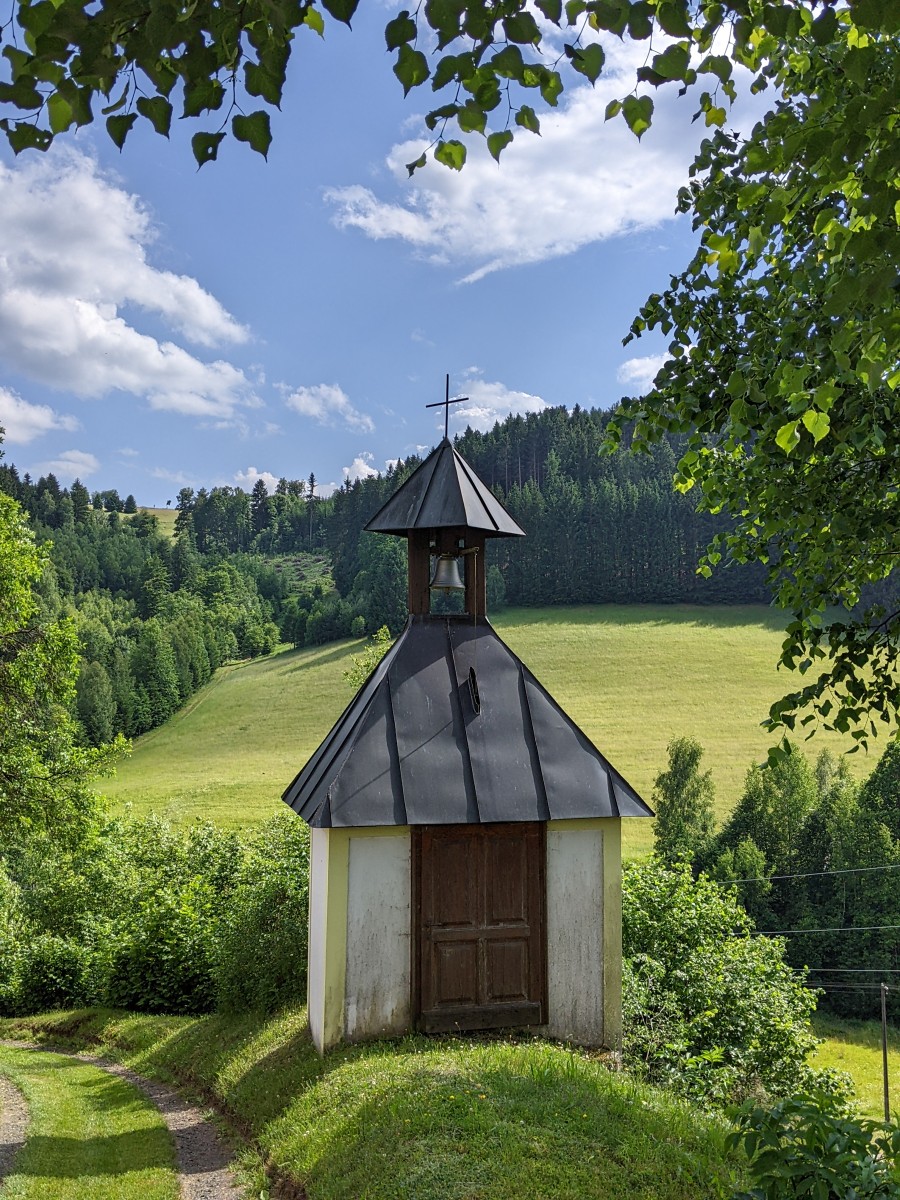
Although Příkrý does not have a church, you will find bell towers there, three of them in fact. The first two are in the village of Příkrý and the third in Škodějov. The first bell tower is in the lower part of Příkrý above the little Vošmenda River. The most well-known bell tower, the upper one, was built in the supposed centre of Příkrý in the first half of the 18th century. It is a wooden structure on a square sandstone base. Its high conical roof supports a turret with arched windows and a minaret, topped with a two-armed cross. The bell tower contains the original bell from the first half of the 18th century.
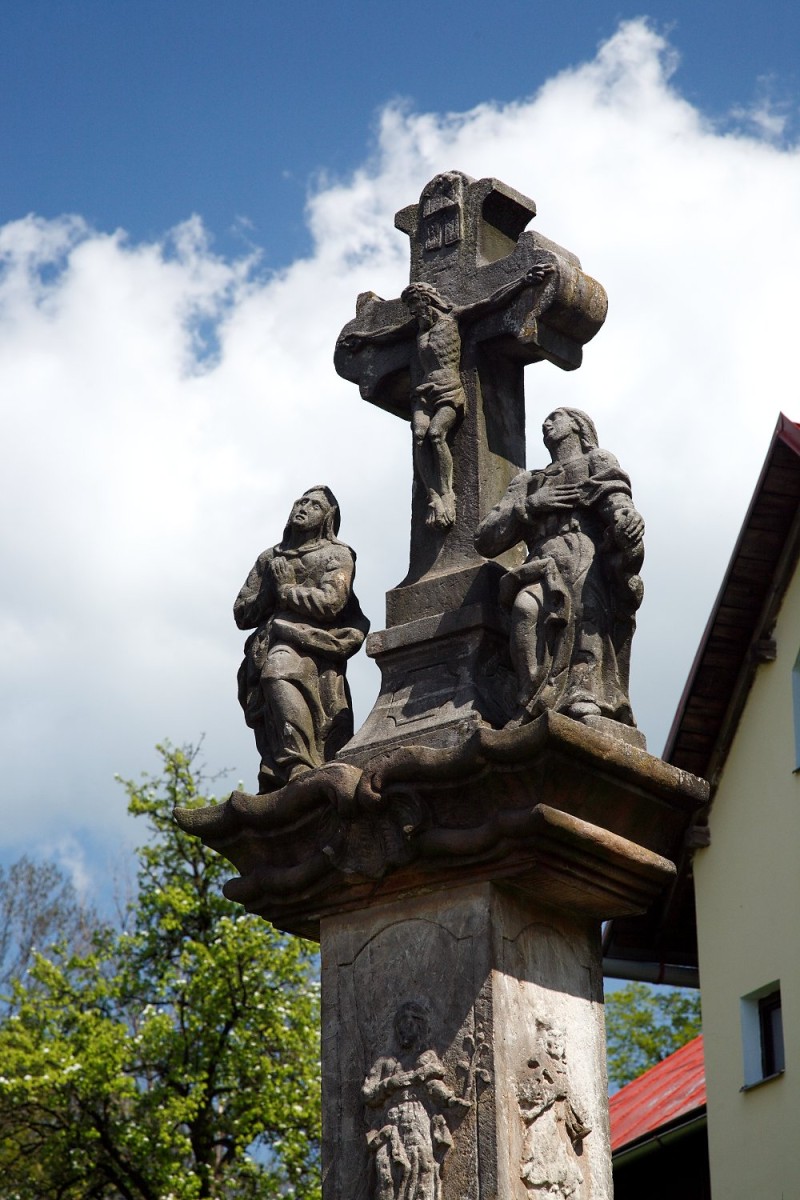
There are another two important monuments near the upper bell tower – the Calvary and the wayside shrine. The group of sculptures depicting the Calvary dates from the second half of the 18th century, is carved from ochre-coloured sandstone, and is probably the work of the stonemason František Fiala from Turnov. The low plinth supports a four-sided prismatic body, decorated with reliefs on all four sides. They depict St. Joseph, St. John of Nepomuk, St. Wenceslas and St. Augustine. The body is topped by a massive profiled cornice, bearing the statues of St. John the Evangelist and the Virgin Mary, and a cross showing Christ during his crucifixion.
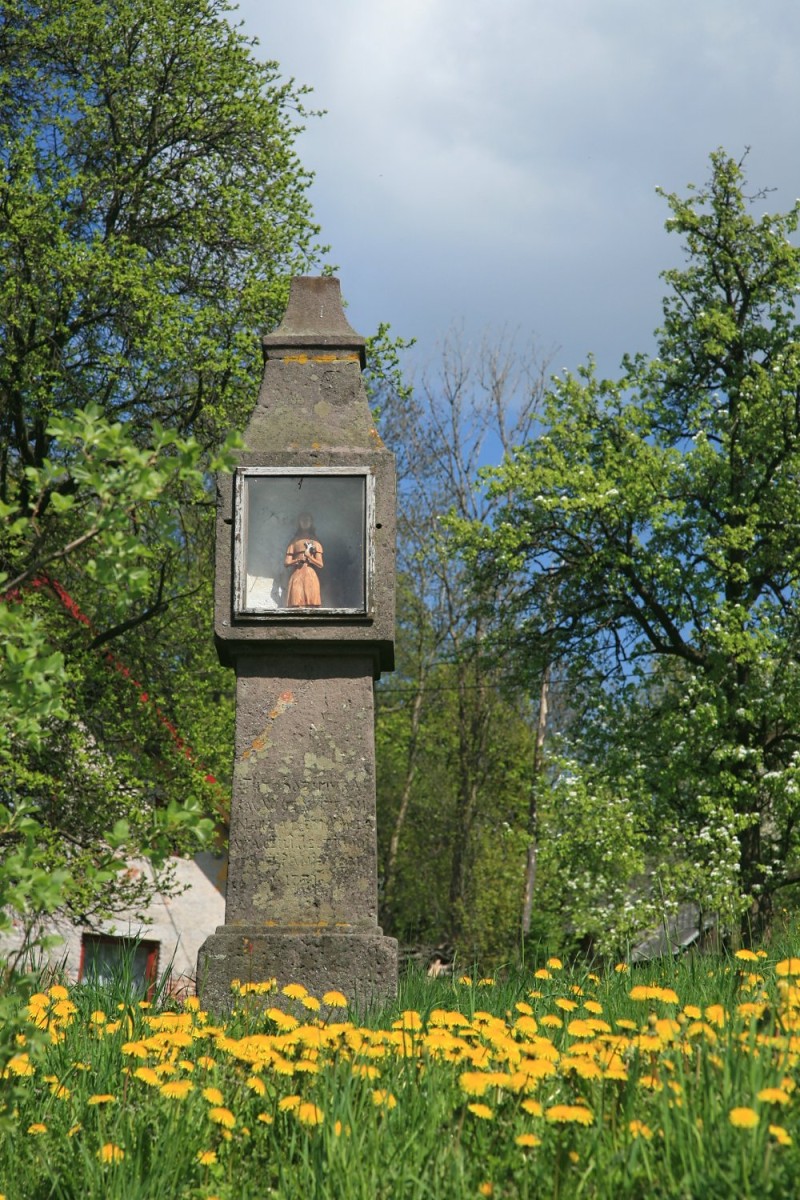
The wayside shrine dates from 1731 and is also made from sandstone. The four-sided prismatic body is topped with a stone niche chapel, the front of which bears the original carved inscription: TYTO BOZI MVKA SAV WYZDWIZENI NAKLADEM WACLAWA CIILI KE CTI RODICE BOZI PANIE MARIE 1731. (This wayside shrine is erected at the expense of Václav Cíla in honour of the Virgin Mary Mother of God 1731).
Several timbered buildings typical of the folk architecture of the Giant Mountains foothills have also survived in Příkrý. These include the very well-preserved cottage no. 64 at the place known as Kozí roh (Goat’s Corner), which dates from 1869 and is listed as a cultural heritage site.
Škodějov
Originally a separate village, Škodějov was annexed to Příkrý in 1971. Škodějov lies in the sprawling valley of the Honkův stream, which is bordered by rolling countryside topped by the Na Vrších hill (593 m a.s.l.), from where there are beautiful views of the Giant Mountains, Ještěd and Kozákov ridges.
The first written record of Škodějov dates from 1388. In 1834 the village had 242 inhabitants, although there are just 43 today.
The old copper mines at Na Rybníčku were reopened in in 1858. The mined ore was transported from there to Horní Rokytnice, where it was processed.
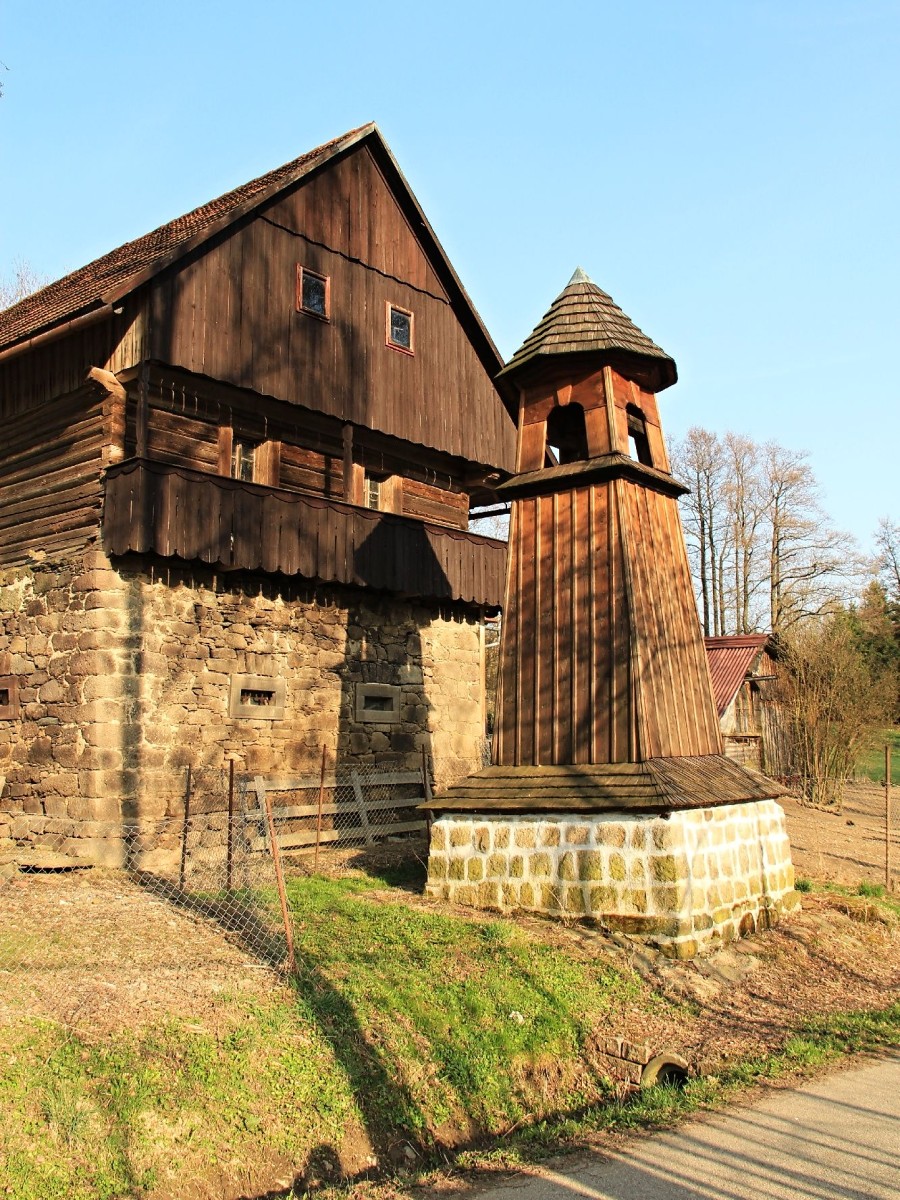
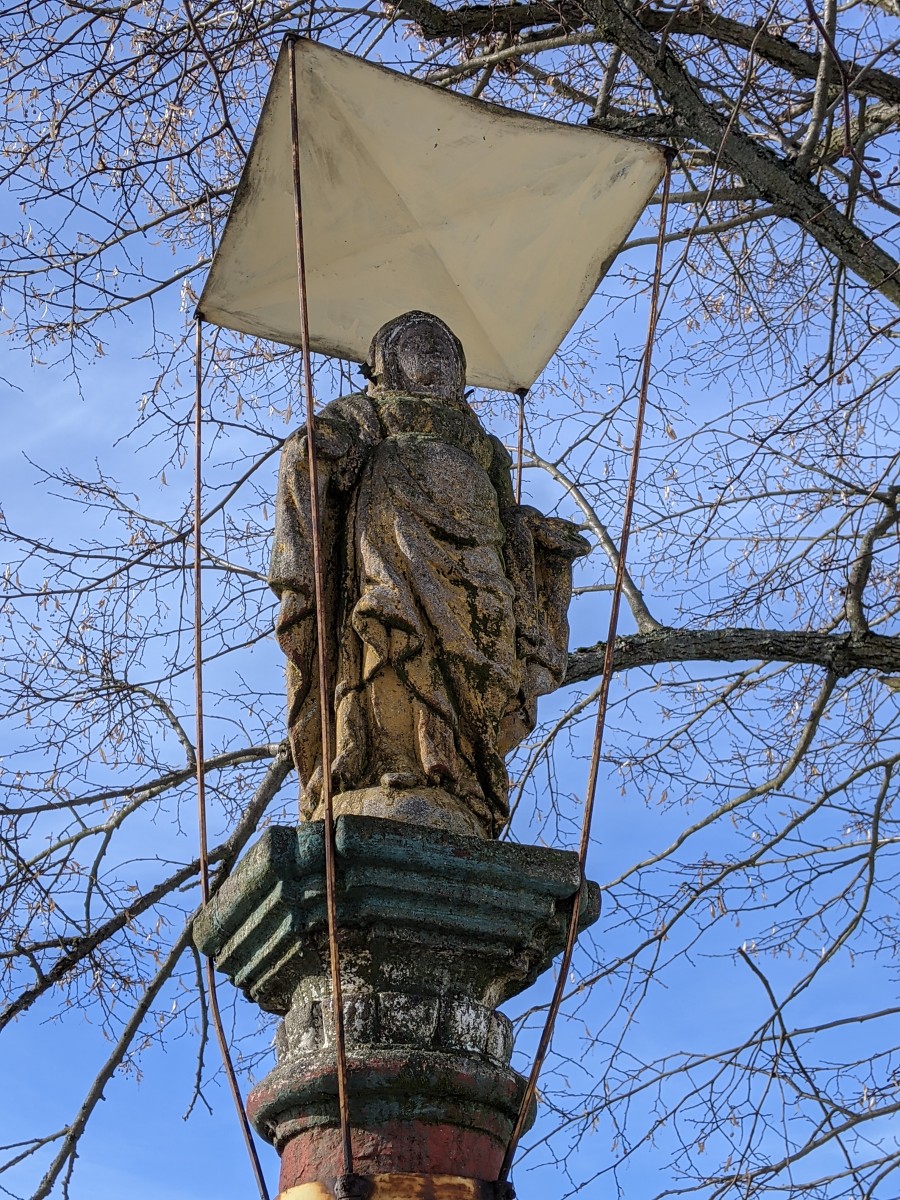
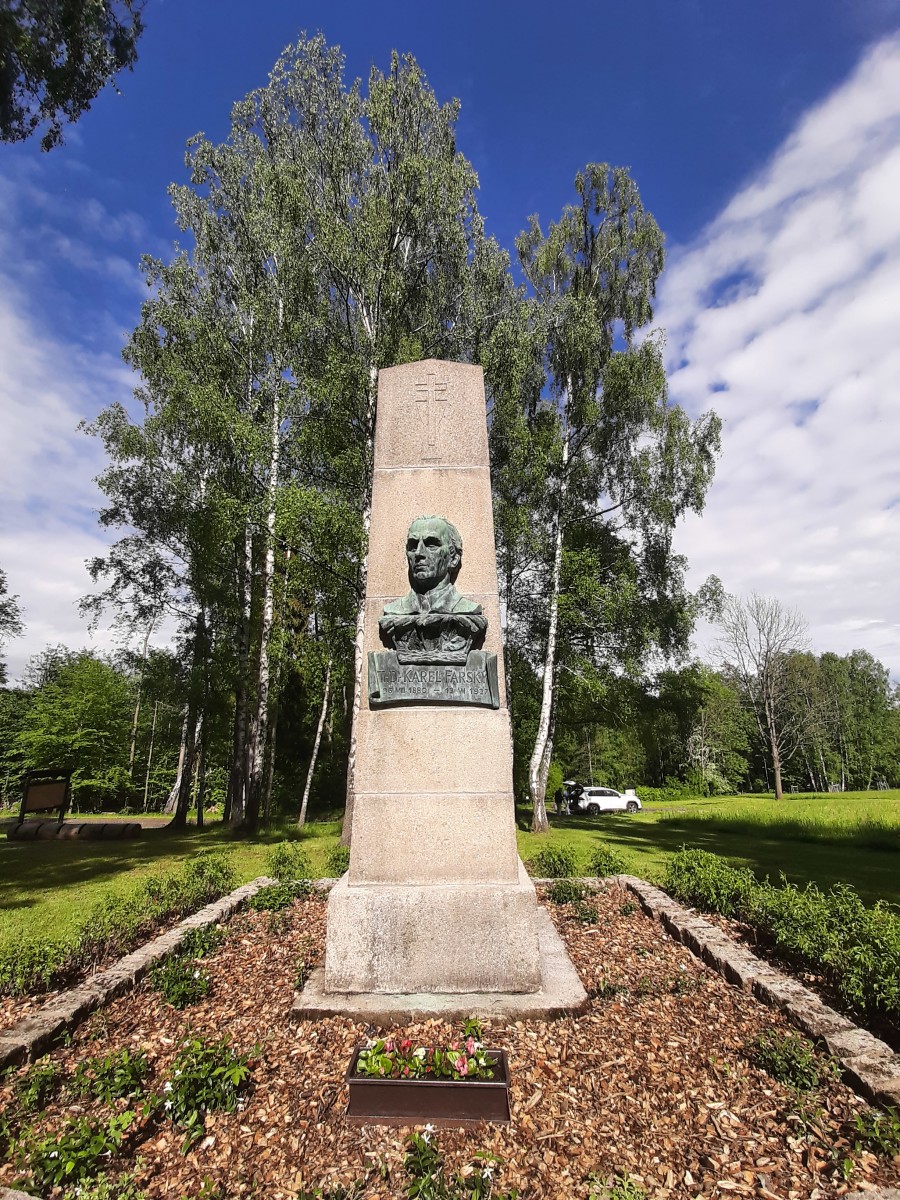
Škodějov contains a number of small heritage buildings, such as the column with its statue of the Virgin Mary from the early 19th century, a listed monument that can be found by the turn-off from the main road, the picturesque little 19th-century wooden bell tower by farmstead no. 18, the niche chapel and the memorial to ThDr. Karel Farský, a local man who was the first patriarch of the Czechoslovak Hussite Church. The Dr. Karel Farský forest chapel was built in the little wood above the village in 2017.
The marked supraregional cycle trail 17 – the Greenway Jizera – runs through through Škodějov.
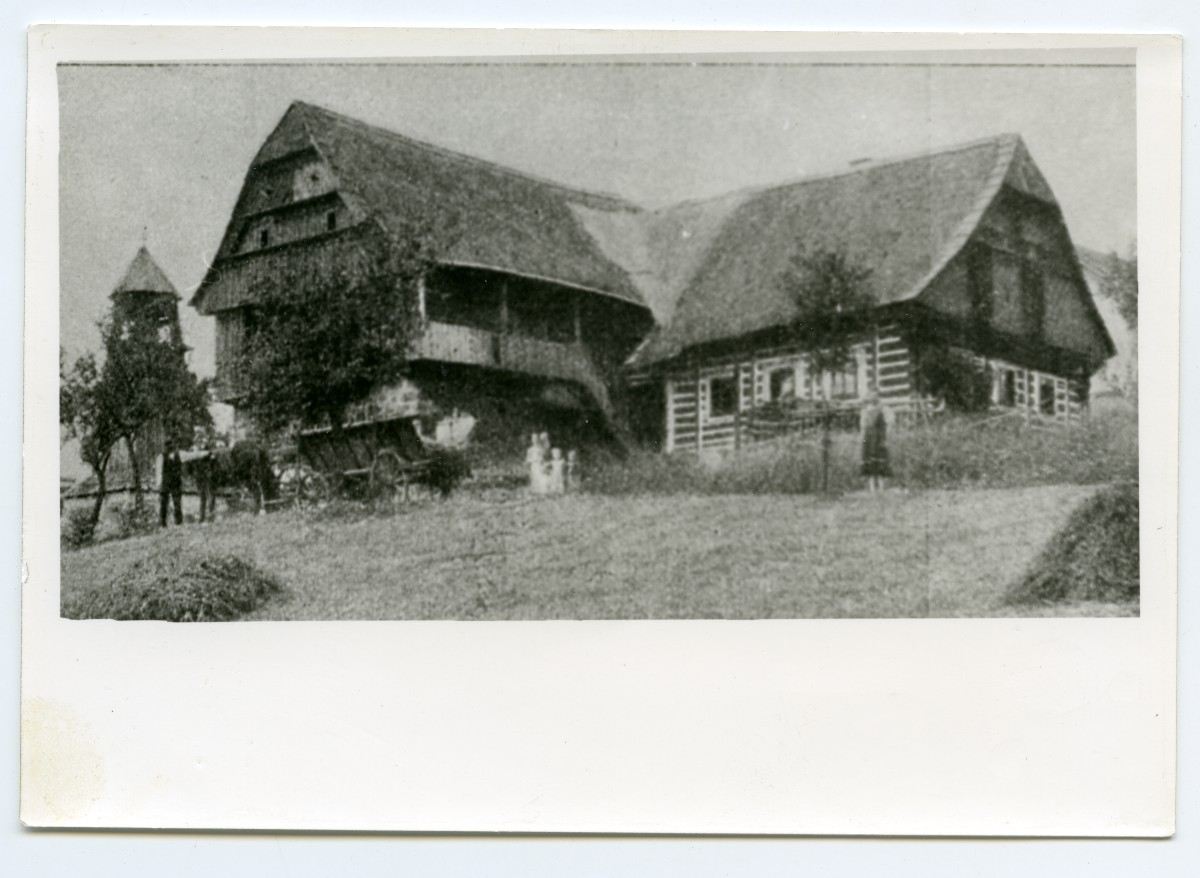
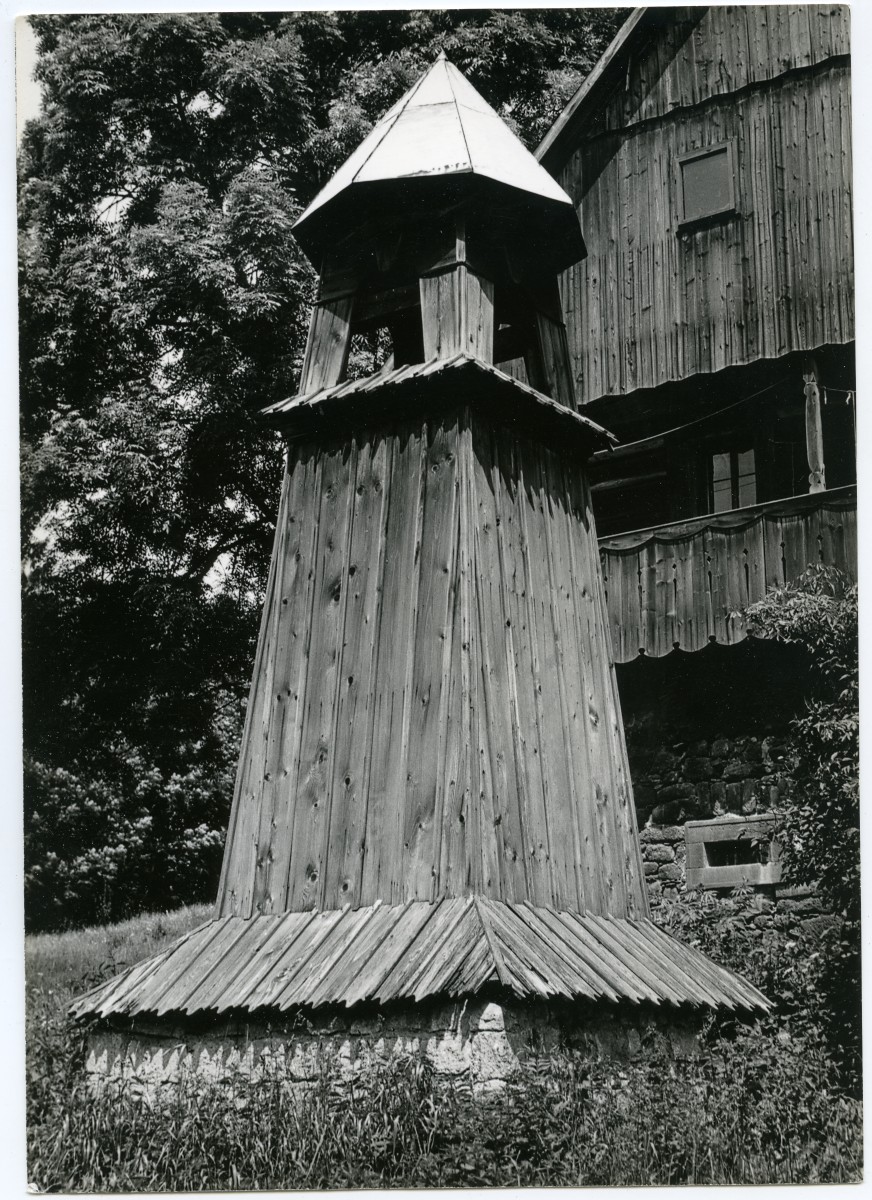
Wooden bell tower in Škodějov
Some kind of timbered building, typical examples of the folk architecture of the Giant Mountains foothills, can be found in almost every village in the Horní Pojizeří region. They are proof of our ancestors’ mastery of the art of building and give us an idea of how these villages looked a few centuries ago. Where the village’s inhabitants took care of their buildings in the past, we can find preserved examples of residential cottages and farm buildings, as well as some small sacral buildings, amongst others. Bell towers played a crucial role in villages and towns, informing the locals of special events both happy and sad, and also served as a warning system in the event of a fire, for example. Příkrý has been lucky as far as bells are concerned, as a total of three have been preserved, one of which is here in Škodějov.
Together with the neighbouring timbered farmstead, Škodějov’s charming bell tower by the municipal road to Háje nad Jizerou is a picturesque spot. The bell tower has a brick “two-walled” square base. The granite stones on the outside are new, while the inner sandstone and conglomerate ones are original. The date 1849 is carved on the stone by the entrance to the bell tower, which is hard to read but may indicate when it was built. Other sources, however, date it to 1822, so the later date more likely tells us when it was reconstructed. Above the broad base of the bell tower there is an eave roof from two rows of cut shingles. The main wooden part is formworked and fitted with slats; it narrows towards the top and ends in a shingle cornice. At the level of the bell there are four modestly decorated windows and the roof above them is in the shape of an octagonal pyramid with a tin tip, although there is no longer a cross. The iron bell, 40 cm in diameter and 35 cm high, is modern and completely free of ornamentation. The original one was requisitioned during the First World War.
Although Škodějov's municipal bell tower has suffered somewhat from more recent alterations (the granite base, the replacement of the decorated canopies, the removal of the cross), it and the neighbouring farmstead are valuable examples of rural folk architecture.